Paper: Analytical solution of the transient Reynolds equation for finite hydrodynamic slider (pad) bearings monotonically curved in the sliding direction.
Author: George K. Nikas
Published in: Proceedings of the Institution of Mechanical Engineers
(IMechE), Part C: Journal of Mechanical Engineering Science, 2026; in
press.
Abstract
An analytical solution of the classic Reynolds equation for the fluid film lubrication of finite hydrodynamic slider (pad) bearings monotonically curved (convex) in the sliding direction is developed, covering steady and unsteady conditions. It allows for nonzero inlet pressure to account for fluid inertia. Some scarce analytical solutions exist for plane and exponential film shapes but none for generally curved (convex) shapes. The new solution is validated against analytical and numerical results on plane, exponential and parabolic film shapes with excellent agreement. Analytical equations are developed for various performance variables, including the bearing load, the frictional forces, the centre of pressure, the fluid velocity vector, the thermal power or power loss and the temperature rise by viscous heating, the squeeze time, the lift-off speed, and the film stiffness. A sufficient condition is proved to check for inlet backflow. A detailed application example with both steady-state and transient analyses is presented to demonstrate the robustness of the method.
Highlights
A figure from this work
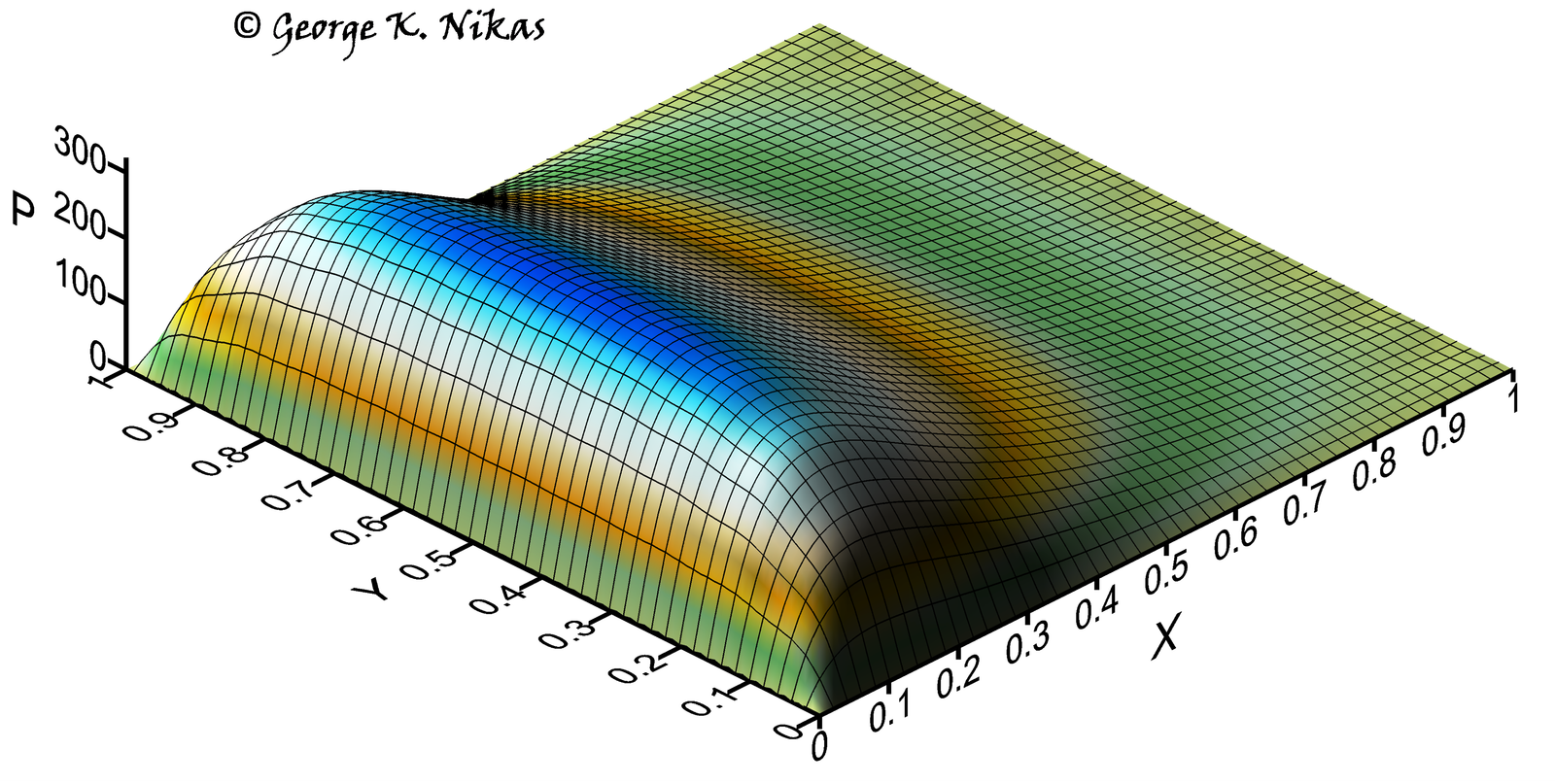
An example of the dimensionless fluid film pressure distribution P(X,Y) obtained with the developed analytical method is shown below. It relates to a slider whose upper (non-sliding) element has profile function h(x) = h0·(1 + s·x/B)3, where h0 is the minimum film thickness, B is the length of the bearing in the sliding direction, and s is a given parameter. Sliding takes place from the inlet at X = 1 to the outlet at X = 0. The side exits of the bearing are at Y = 0 and Y = 1.